Cathode Active Materials
The active materials in a battery are those that participate in the electrochemical charge/discharge reaction. These materials include the positive electrode (Cathode), a negative electrode (Anode), and electrolyte. Lithium-ion batteries (LIB) are often categorized by the chemistry of their cathodes. Cathode Active Materials (CAM) are the main elements dictating the differences in composition while building positive electrodes for battery cells.
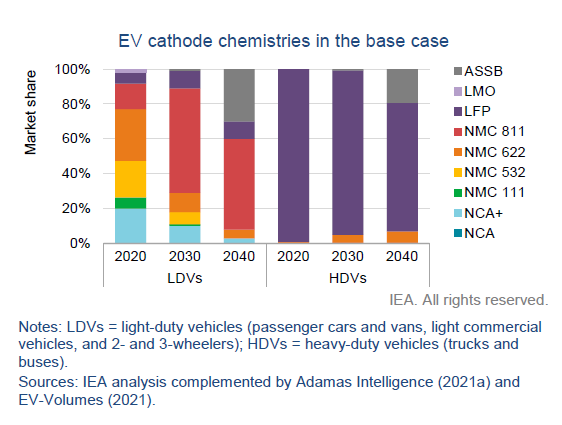
The most commonly used cathode varieties for electric vehicles (EV) are lithium nickel manganese cobalt oxide (NMC) and lithium iron phosphate (LFP). The different combinations of minerals gives rise to different battery characteristics. Although various EV battery chemistries have been developed for EVs to decrease cost and improve performance, current major battery roadmaps in the US, EU, Germany, and China focus on cathode material development considering high-energy NCM 811 (transition to low cobalt and high nickel content) based chemistries as the most preferred next generation LIBs for Light Duty EVs.